The Warning We Ignored
In 2017, DARPA researchers standing on the stage at the RSA Conference issued a stark warning: autonomous cyber systems capable of machine-speed attacks would eventually outpace any defense requiring human intervention. They pointed to DARPA’s 2016 Cyber Grand Challenge, which proved that AI could find, exploit, and patch zero-day vulnerabilities in real time without a human in the loop.
The ultimate nightmare scenario, as noted by DARPA leadership at the time, was the collision of these autonomous capabilities with quantum processing.
That collision has arrived. But the threat isn’t just that the math is faster; it’s that the entire landscape has fundamentally changed while our defenses have remained static.
The Quantum Maze
To understand why your current cybersecurity posture is obsolete, imagine a traditional cyber attack as an adversary trying to navigate a massive maze to reach your and your customers’ core data.
A classical, deterministic attack uses bits to make linear decisions at every turn: Do I go left or right? The adversary’s AI fuzes payloads, pings ports, and brute-forces credentials. It hits dead ends, backtracks, and tries again. This trial-and-error process is loud. It leaves a massive trail of telemetry, for example, failed logins, binary differentials, and anomalous traffic spikes. Your Intrusion Detection Systems (IDS) and Intrusion Prevention Systems (IPS) are designed to detect these indicators of compromise.
But quantum-powered AI attacks do not play by these rules.
Quantum bits (qubits) use two core principles of quantum mechanics: superposition and entanglement. Instead of testing paths one by one, a quantum system manipulates the mathematical probabilities of the maze itself. It amplifies the correct path and cancels out the dead ends, allowing the adversary to bypass the maze exponentially faster than traditional brute force. To the defender, it looks as though the attacker simply materialized at the center.
The Modern Trojan Horse
How does a quantum-powered adversary get the initial access required to pull off this off? They don’t try to break down the front door.
Instead, they leverage the modern software supply chain to slip a piece of the advanced persistent threat (APT) directly into your environment inside standard, everyday system updates.
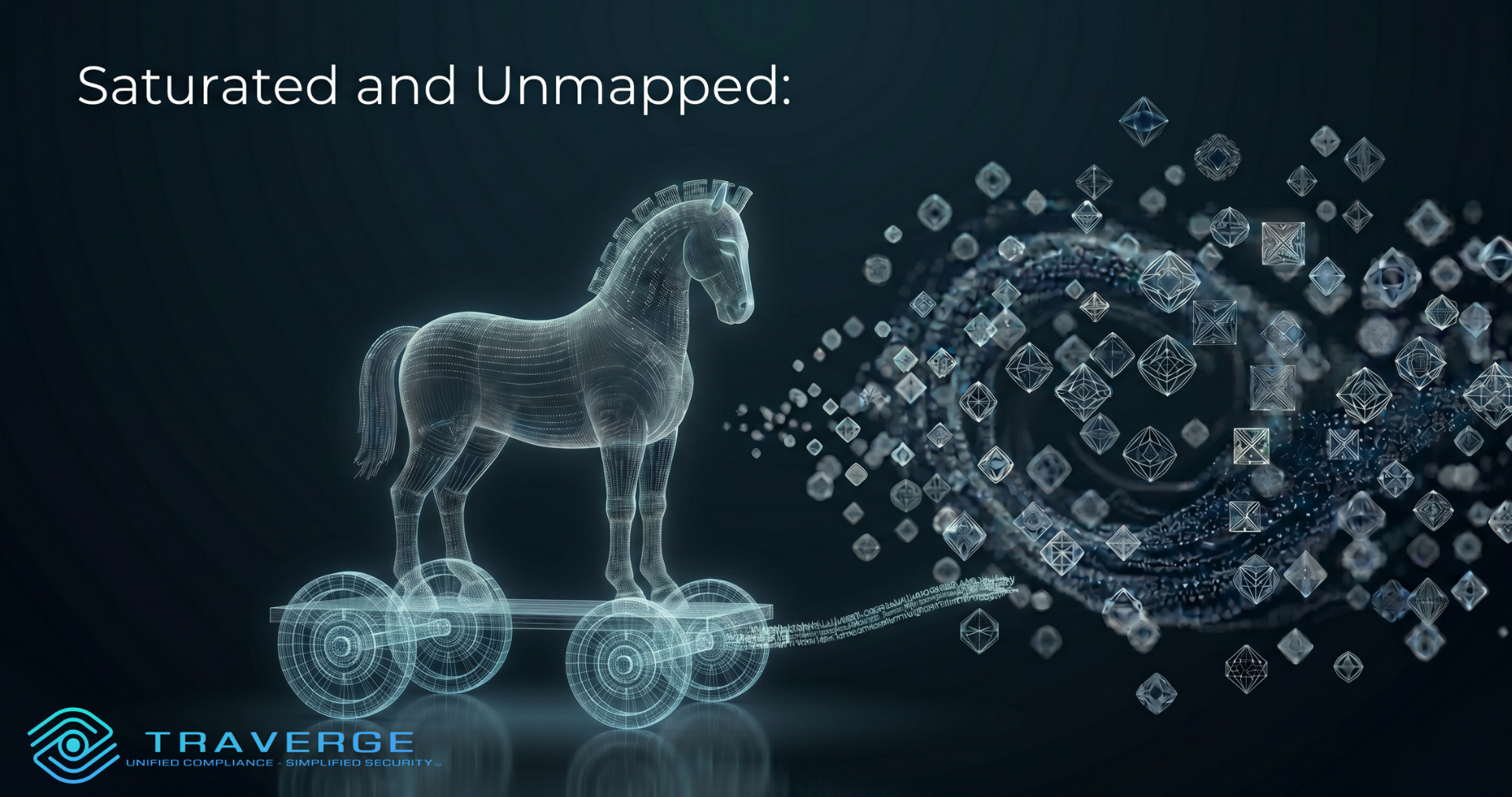
Think of your Identity and Access Management (IAM) protocols as a strict bouncer standing at the door of an exclusive club. Most cybercriminals waste time trying to argue with or slip past the bouncer. A quantum-powered AI APT takes a different approach: it hides inside a Trojan horse that your developers have already wheeled past the front gates. Once inside the perimeter, the asset quietly wakes up, walks over to the guest list, and writes the attacker’s name at the very top.
When the adversary finally connects, they don’t look like an intruder hacking the system; rather, they look like the guest of honor.
The Compliance Illusion
Because the quantum attack unravels the underlying cryptographic math offline, it bypasses the entire trial-and-error phase. The adversary doesn’t need to guess passwords or brute-force credentials; they forge a mathematically perfect access token. There are no failed logins. There are no pings to closed ports.
The adversary hits the correct IP address, targets the correct port, and successfully authenticates with perfectly calculated parameters.
This creates a terrifying paradox for federal stakeholders. Your system can be 100% compliant with NIST SP 800-53 Rev 5 baselines and FedRAMP 20x Key Security Indicators (KSIs). Your automated OSCAL compliance pipeline will ingest telemetry, validate your system data, and display a perfect, green dashboard.
The compliance package says everything is clean. But the adversary is already inside, masked by the very validation tools designed to keep them out.
The Regulatory Blind Spot: A Shared Failure
Your current compliance posture is built to look for yesterday’s threats. Federal frameworks scan for classical, known signatures. They are completely blind to a malicious Trojan horse hiding inside an authorized software update that crossed your secure boundary months ago.
This blind spot creates a split-directional risk that threatens both sides of the federal acquisition boundary:
- The Sourcing Gap (DoD & SWFT): Programs like the DoD’s Software Fast Track (SWFT) require Software Bills of Materials (SBOMs). However, standard SBOMs only examine text manifests; they do not probe deeply enough into the math of embedded AI models to detect behavioral backdoors.
- The Static Boundary (FedRAMP): A FedRAMP authorization covers the platform as it existed at the exact point of assessment. It does not dynamically audit continuous micro-model updates or AI-generated code dependencies that slip into production cycles under the radar.
The Collision Course: Revenue vs. Regulation
Executive Order 14409 and NIST’s upcoming COSAiS (Control Overlays for Securing AI Systems) are rushing to close this gap by mandating specific AI vulnerability scanning. CISA’s upcoming Binding Operational Directives will legally compel federal agencies to secure these pipelines.
The clock starts the moment they are published. While standard NIST guidance under OMB A-130 grants agencies a comfortable one-year grace period to comply, CISA’s directives obliterate that timeline, forcing aggressive, non-negotiable implementation windows measured in days, not months.
For Agencies: Pointing to a vendor’s static FedRAMP package is no longer a legal shield. When the CISA directive lands, the obligation to verify the AI security posture falls squarely on you, the authorizing official or mission owner.
For Cloud Service Providers (CSPs): Having an authorized Cloud Service Offering (CSO) will not protect your federal revenue when agency customers start asking hard questions. If your monthly continuous monitoring package or automated OSCAL pipelines cannot answer what AI is running inside your boundary, what measures are in place to monitor it, and how it is governed, your leveraging agencies may drop your service to avoid inheriting the risk of non-compliance. Your certification and your federal contracts are explicitly exposed.
Waiting for the regulations to finalize before mapping your AI risk isn’t just a legal gamble; it is operational and financial negligence.
The Solution: Map the Meridian
Stop guessing where your software supply chain ends, and your vulnerability begins. You cannot defend an environment or protect a revenue stream that you cannot see.
Before the upcoming CISA directives force a frantic, short-window compliance scramble, proactive leaders must draw a new line of defense.
Traverge conducts comprehensive AI System Boundary Mapping. We look past standard text manifests and deep into the nested dependencies, interconnected APIs, and stealth integrations running inside your production environments right now.
For CSPs: This map is the definitive technical proof you can hand to your federal customers to validate your security posture, satisfy COSAiS requirements, and protect your multi-million-dollar contracts.
For Agencies: This mapping provides the empirical foundation your agency needs to meet the requirements of the CISA Binding Operational Directives before the strict deadlines expire.
The landscape is changing. The compliance illusion is over.
Request an AI System Boundary Mapping Session with Traverge at traverge.com/contact.
Stay Tuned!
In Episode 2: Tactical Countermeasures (Operationalizing AI Red Teaming Against Next-Gen Threats), we move from analyzing the vulnerability to actively hunting the threat. We will explore how traditional, reactive security testing fails against machine-speed attacks and why organizations must adopt continuous, behavioral AI red teaming. You will see exactly how defenders can shift from static checklists to active deception, building dynamic traps within the network to catch an adversary who already holds the keys to the kingdom.
Traverge, LLC is an SBA-certified Service-Disabled Veteran-Owned Small Business headquartered in Jacksonville, FL. We provide federal cybersecurity consulting, Zero Trust Architecture, DevSecOps, offensive security, and AI governance services to the defense, federal, and intelligence communities.