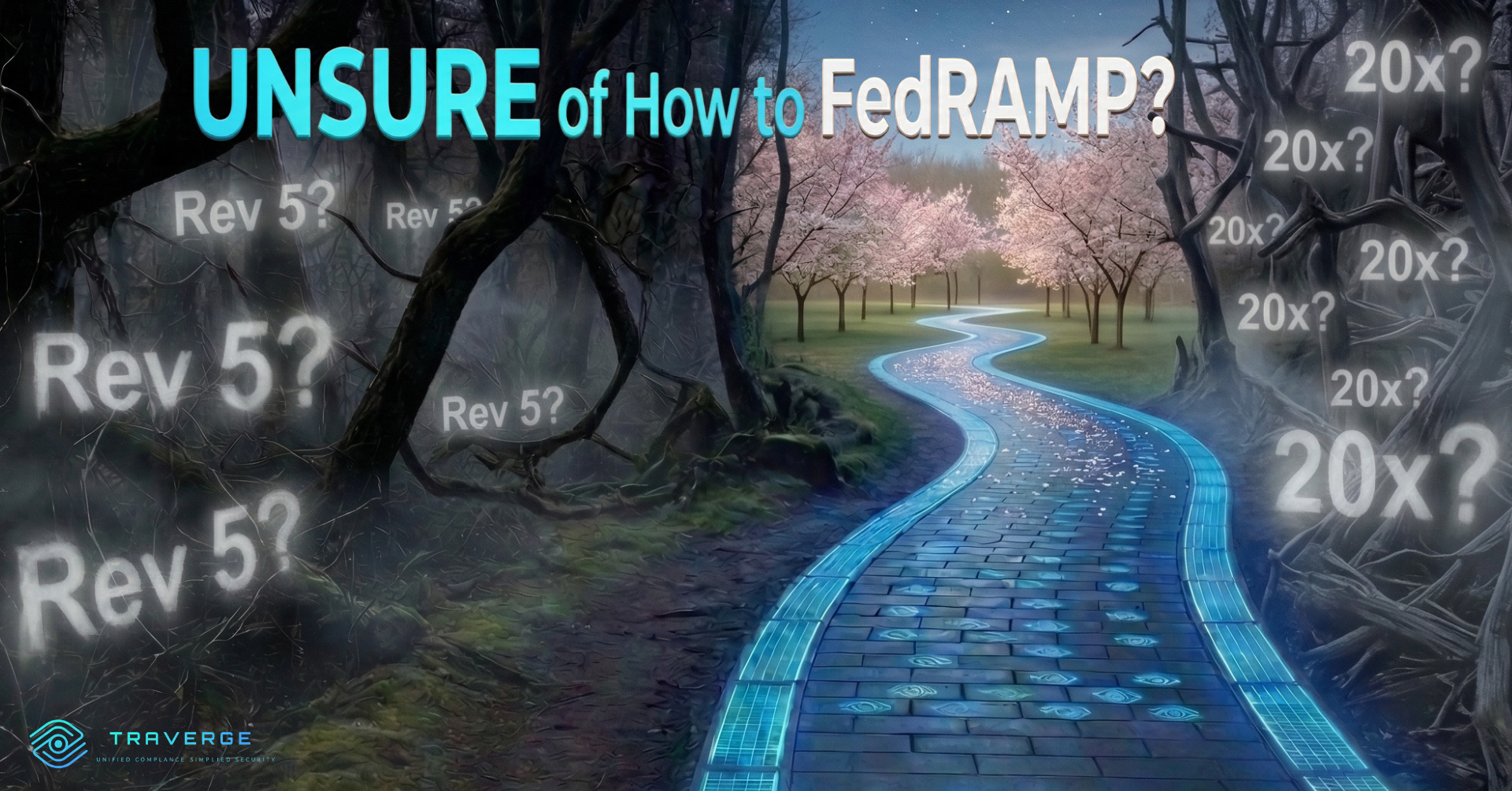
We hear a version of the same question almost every week now.
A Cloud Service Provider (usually one that has been building toward FedRAMP authorization for months, sometimes years) comes to us with some variation of this: “Should we keep going with Rev 5, or wait for 20x? We don’t want to spend all this money on something that’s about to change.”
I’ve been directly involved in federal compliance for the better part of 20 years, 15 of them dedicated to FedRAMP, and I’ve heard some version of this question at every incremental update. Even with the shift from Rev 5’s document-based approach to FedRAMP 20x’s continuous, outcome-based model, the question remains the same.
It’s a fair question. The federal cloud compliance landscape is in flux, and any CSP paying attention to the PMO’s roadmap has reason to pause. But the answer hasn’t changed as in most cases, the hesitation is based on a misunderstanding of what 20x actually changes, and more importantly, what it doesn’t.
The short answer we give our clients: the work you do to prepare for FedRAMP is almost entirely the same regardless of which authorization pathway ultimately applies to you. The significant difference between Rev 5 and 20x is not what you have to secure. It is how you prove it.
If you’re a new CSP and waiting for the dust to settle before starting your FedRAMP journey, you are losing time you cannot get back.
What Is Actually Happening Right Now
FedRAMP 20x is not speculation about a future update. It is an active, phased program with a defined timeline and real deadlines that affect decisions you need to make today.
For FedRAMP 20x
- Phase 1 (Class B/Low Baseline) is complete. Thirteen CSPs received authorization, some in as little as two to three weeks, compared with three months to a year-plus for a typical Rev 5 authorization.
- Phase 2 (Class C/Moderate Baseline) pilot is underway, with approximately 10 Moderate authorizations targeted by the end of Q2 2026.
- Phase 3 (Wide-Scale Adoption) is targeted for Q3–Q4 2026, opening the 20x pathway broadly for Class B (Low) and Class C (Moderate).
For existing and future FedRAMP Rev 5 authorizations
- September 30, 2026, is the OSCAL machine-readable deadline, but the specifics matter. For new Rev 5 submissions, OSCAL is required on or after this date. Existing authorized CSPs must comply with their next annual assessment after this date. Any CSP not transitioned by September 30, 2027, will be subject to public notification of non-compliance and potential revocation, requiring a full restart.
- New Rev 5 agency authorizations are expected to end by Q3–Q4 2027, with all existing Rev 5 authorized cloud service offerings (CSOs) required to transition to machine-readable authorization.
The Overwhelming Similarity Between Rev 5 and 20x
Both pathways share the same risk-management philosophy and federal data-protection mission. The fundamental question hasn’t changed: Does your cloud system adequately protect federal data? What’s changed is how you prove the answer.
- The security engineering work is the same. Both pathways require the same core outcomes: encrypted data, strong authentication, comprehensive audit logging, incident response, configuration management, and vulnerability management. Every GovCloud hardening, zero-trust implementation, and DevSecOps pipeline you build today is directly relevant at 20x. Automation and strong security engineering are exactly what 20x rewards.
- The authorization boundary still needs to be defined. Scoping your system, identifying data flows, documenting your architecture, and establishing what is in and out of scope is foundational work that applies equally to both pathways.
- Independent validation remains required. 3PAOs remain part of 20x, though their role shifts from point-in-time narrative assessments to continuous validation against the KSI framework, with automated evidence carrying more of the weight. The oversight doesn’t disappear. What changes is how it gets exercised.
- Sustained security is mandatory in both. Vulnerability management, finding remediation, boundary maintenance, and ongoing security health are required regardless of the framework. The discipline doesn’t change. How you report it does.
Across the programs we’ve run, 80 to 90 percent of what it takes to get authorized is framework-agnostic. It is the grind of building secure systems and demonstrating it in a way that an independent validator can confirm.
The Differences, and They Are Fewer Than You Think
The meaningful differences between Rev 5 and 20x come down to one core theme: the shift from static, narrative-based compliance to automated, outcome-based validation.
- The SSP, as you know it, will be retired. Rev 5’s narrative SSP and (Appendices A through Q) are replaced by an OSCAL-formatted package built around KSI Summaries and 10 Core Processes. The shift is fundamental: instead of writing that your system “uses complex passwords,” your system outputs a machine-generated log proving it. Narrative says it. Telemetry proves it. See the table below for specific document-level changes.
- The compliance framework has consolidated significantly. FedRAMP 20x replaces the 323 Moderate Rev 5 controls with outcome-based KSIs across 11 themes, resulting in a roughly 80% reduction in compliance items. The Moderate baseline currently sits at approximately 61 KSIs, with some still in RFC status. That is not a lower security bar. It’s a shift from prescriptive narrative documentation to measurable, automatable outcomes.
- Reporting cadence shifts from monthly to real-time. Rev 5 ConMon runs on a monthly cycle: scans, POA&M updates, annual 3PAO assessments, and package submissions. FedRAMP 20x replaces this entirely with continuous authorization and automated telemetry updated within hours. For teams built around the traditional monthly cadence, this is the most operationally significant change.
The Dual-Path Strategy: What We Actually Recommend
Start now. Structure for 20x. Pursue your Rev 5 authorization; it is the proven pathway available today, and more importantly, the authorization path recognized by the vast majority of federal agencies. Structure your documentation, engineering, and evidence collection for 20x from the beginning.
I’ve run this exact play. When I led the Rev 4-to-Rev 5 transition at a major cloud provider, the security control implementations didn’t change. The documentation architecture did. CSPs with structured, modular SSP content made the transition efficiently; those without spent more time reformatting than they had building it. Plan for 20x from day one.
- Build your SSP content in a structured, clean format. Architecting your control descriptions in a consistent, well-organized structure means your 20x transition requires reformatting rather than rewriting.
- Invest in automation now. Every CI/CD pipeline, IaC module, and automated scan you build today directly satisfies 20x KSI requirements.
- Get your ConMon house in order. Mature, well-documented ConMon programs build agency confidence and smooth the 20x transition.
- Don’t wait for agency-side 20x adoption to catch up. Agencies are at various stages of 20x readiness; some will prefer Rev 5 packages through 2027. A dual-path program means you don’t lose a deal over the authorization path.
How Traverge Helps You Navigate Both
Our team has been embedded in FedRAMP since its earliest days and has served as 3PAO Lead Assessors, Agency ISSOs, and CSP Program Managers. We know exactly how auditors will test what you’ve built, because we have been those auditors.
We meet you where your GRC tools are. If you already have a 20x-compatible GRC platform in use, we integrate directly with your existing toolchain. We’re tool-agnostic. Our value is the expertise, not the software.
Engineering depth, not just advisory. Our practitioners have hands-on backgrounds in AWS GovCloud, Azure Government, GCP, Kubernetes, and DevSecOps. We help you build the automated environment that 20x rewards, not just document the one you have.
Continuous Monitoring that actually works. An under-resourced ConMon is one of the most common reasons FedRAMP programs stall. Our managed ConMon services keep your program current and audit-ready, whether you’re on Rev 5’s monthly cadence or building toward 20x, freeing your team to focus on revenue-generating work.
The Bottom Line
The federal cloud market is not waiting. The PMO is actively incentivizing participation, and the CSPs building their authorizations now will be positioned to capture contracts when 20x opens broadly in late 2026. The uncertainty about which path you’ll end up on is real. The preparation is largely the same either way. The risk of waiting could be the difference between you and your competitor landing that contract.